
Foreword: Professional Collaboration Matters
11 June, 2026By Anne Wilson, May 2026
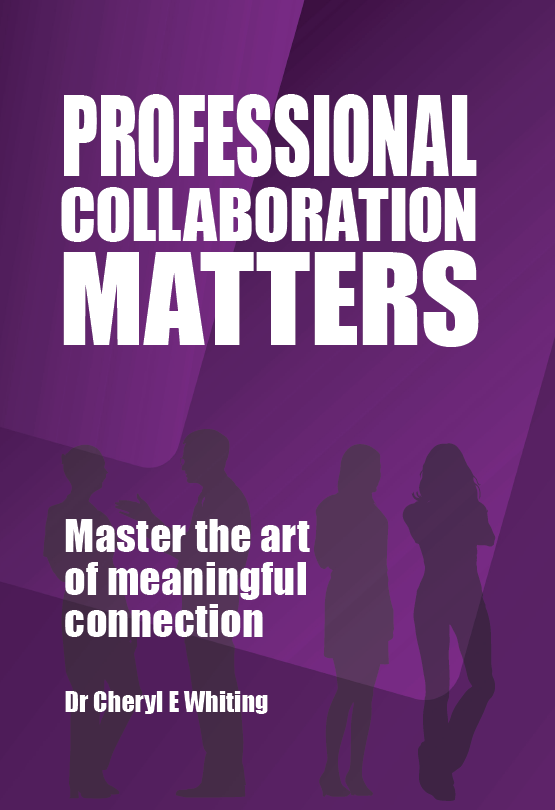
I’m delighted to have been invited to write the foreword to Professional Collaboration Matters, Dr Cheryl Whiting’s latest and timely book. As someone who has worked in leadership roles within Higher Education and local government, and more recently as a freelance trainer and career coach, I have skin in the game. I’ve experienced both fruitful collaborations and some less-than-ideal scenarios. When collaboration works well, everything flows. The contribution of each partner often exceeds the original project outcomes. Relationships flourish, leading to future opportunities and recommendations, and stakeholders are happy. Individual reputations are enhanced, and organisations enjoy the accompanying positive publicity. Most importantly, services to clients are enhanced.
I first met Cheryl in 2023, when she was in the process of publishing her first book, Professionalism Matters. Cheryl’s laser focus on the importance of the topic and the formal recognition she received through her Doctorate gave her gravitas on this subject. I knew she would apply the same depth of insight to the topic of collaboration.
The key message of Professional Collaboration Matters is that collaboration is a skill that anyone can learn. We all have the potential to collaborate well. Fundamentally, collaboration is a dynamic process. While knowing why you want to collaborate is key, so too are our behaviours and how we show up. While processes and structures matter, they can’t replace a lack of professionalism, values, emotional intelligence, and self-awareness.
Communication is key. Understanding and conveying your ideas, thoughts and hopes are important. Listening to your prospective collaborators equally so. There is no place for ego. Partners need to be equal in the collaboration dance. The most important goal of any collaboration is the impact on your mutual client.
When I reflect on the collaborations that went less well for me, Professional Collaboration Matters would have been an incredibly helpful resource to have had at my disposal. Cheryl undertakes a forensic analysis of what makes collaboration effective through her research into the experiences of others. By picking apart the requisite qualities, conditions, and processes, she enables the reader to increase the likelihood of fruitful alliances.
At the end of each chapter, there is a section headed ‘Points to Ponder.’ This encourages the reader to reflect on the different aspects of the collaborative process. For me, these reflective questions are what add unique value to the book. They are a very effective way, not only to absorb the key information contained in each section, but to engage in reflecting on the different ways you are personally engaging in collaboration. This is invaluable when considering, for example, why you might collaborate, how collaboration might benefit you and your business and how you’re feeling about the process.
From my own experience, I reflected that while I’m good at establishing effective working relationships with partners, detail is not one of my strengths. The opportunity to pause and clarify my hopes and expectations for all parties, including likely time commitments, would have been helpful to map out beforehand. This would have undoubtedly helped me close loopholes and avoid some friction once a project was underway.
Completing the ‘Points to Ponder’ systematically would have ensured I was better positioned to engage fruitfully with prospective partners. I would have been clearer about the purpose of collaborating, felt better prepared and approached prospective collaborators more professionally. By reflecting regularly, I would have appreciated what was working well and where I needed to pay greater attention.
The world of work is in flux. The advent of AI adds an extra dimension. Individuals and organisations are constantly required to explore more effective and efficient ways of working. Opportunities to collaborate will increase- whether out of necessity or by design. The most innovative ways to improve outcomes for clients often come from individuals who bring their complementary strengths and imagination together to solve problems and improve services.
Professional Collaborative Matters is therefore a most timely publication. It will help many more people become not just more effective at working in partnership, but also help individuals and organisations transform the way they work together.
Anne Wilson, SFHEA
Award-winning trainer, speaker, licensed Strengths practitioner and Firework career change coach.
Website: www.thecareercatalyst.co.uk
Copyright May 2026