
Precis of Professional Collaboration Matters
28 June, 2026Written by Professor Ethem Güneren, Turkey
A note from me before you read on
The piece below was written by a former colleague after reading my book.
For several years, I held the position of Visiting Professor at Bezmialem Vakif Universitesi in Turkey. An appointment in recognition of my sustained commitment to international and cross-cultural collaborative endeavours between this organisation and the university and medical school where I was employed at that time.
I keep in touch with many of my colleagues there, and, to my surprise, I received this detailed précis of my new book, Professional Collaboration Matters, from Professor Ethem Güneren, a surgeon and well-established author himself with a large back catalogue of publications.
I was blown away by this selfless and unexpected gesture, and it was a strong reminder that collaboration doesn’t really end when the project does. The work we did together in Istanbul and London continues to manifest in how we think, write, and support each other. A reminder, too, that the relationships formed and the impact we make through collaboration often outlast the collaboration itself.
Although Ethem’s piece leans toward an academic tone (as is the norm in his professional context), it shouldn’t be taken as representative of the book, which is intentionally conversational and practical with strategies that can be applied in everyday practice. However, Ethem’s thoughtful reflections and analysis offer a good overview, highlight the key themes, and give a strong sense of what the book sets out to do—namely, help us all become better collaborators.
With the exception of corrections to spelling, the work is presented here as it was to me. I hope you enjoy it and take something useful from it.
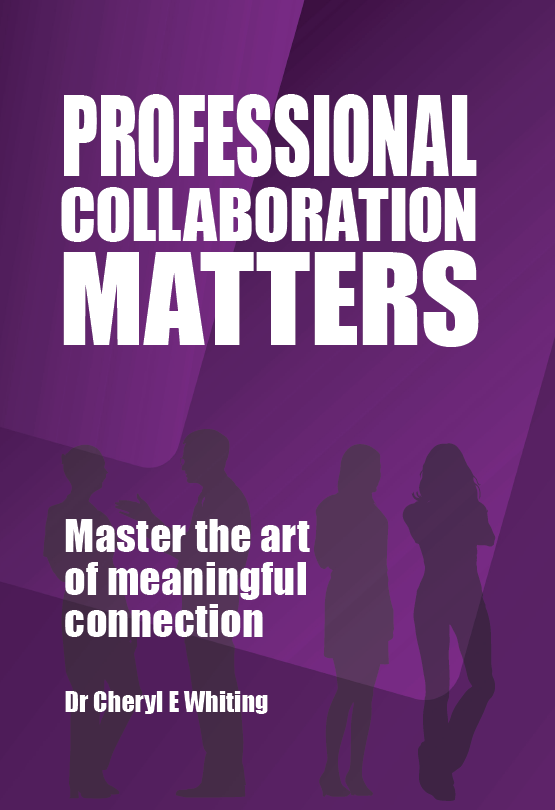
Dr. Cheryl Whiting’s upcoming work, Professional Collaboration Matters: Master the Art of Meaningful Connection:
1. Core Philosophy: Shifting from “Transactional” to “Meaningful”
Whiting argues that the greatest trap in modern professional ecosystems is the institutional pressure to quantify everything through metrics. When employees are reduced to data points, performance charts, or tasks on a screen, collaboration inevitably becomes transactional.
The Author’s Thesis: True collaboration begins when partners stop viewing each other as mere utility tools and start recognising one another as “whole individuals” working toward a shared goal. Building this connection requires cultivating an authentic and distinct professional culture that resists mere corporate superficiality.
2. The Three Pillars of Meaningful Connection
The book deeply examines three critical layers that form the foundation of a sustainable, high-level partnership:
A. Suspending Assumptions (The Client & Peer Horizon)
As professionals, we frequently assume that our own definition of what is “right,” “efficient,” or “ethical” is universally shared. Whiting strongly challenges this:
We must actively acknowledge that individuals from different disciplines, cultures, or backgrounds view the professional landscape through entirely different lenses.
True collaboration does not begin by imposing our own framework; it starts with empathy—by listening to understand the underlying values and expectations of our peers.
B. Confronting the “Hidden Curriculum” of the Workplace
Drawing from her research in educational sociology, Whiting highlights the “hidden curriculum”—the unspoken rules and cultural pressures that operate beneath an organisation’s formal guidelines.
In most modern workplaces, this invisible framework relentlessly prioritises speed, short-term outputs, and blind efficiency.
The book demonstrates how this pressure erodes quality human interaction. Masterful collaboration requires consciously pushing back against this “race for speed” and shifting the focus back to a shared pursuit of excellence.
C. Excellence as a Transient State
One of the most striking philosophical points in Whiting’s work is that professional excellence and harmonious collaboration are never permanent achievements.
Excellence is transient. Much like an athlete who is only as good as their current performance, a professional is only as good as their current interaction.
Therefore, successful partnerships are not stagnant milestones. They are dynamic processes requiring continuous, active, and mutual investment in self-improvement.
3. Practical Approaches: Collaboration as a Craft
Rather than viewing cross-disciplinary partnerships as a series of rigid “hand-overs,” the book treats collaboration as a shared intellectual and practical craft, offering several approaches:
Deep Listening and Authenticity: Communicating openly without hiding behind corporate masks, maintaining professional boundaries while preserving genuine human warmth.
Overcoming the “Good Enough” Trap: Accepting the status quo halts progress. As the author notes: “When we accept good enough, we impose limitations on ourselves and our expectations.”
Psychological Safety and Transparency: Whiting shows that teams capable of openly discussing mistakes and vulnerabilities—rather than maintaining an illusion of perfection—display far greater resilience during crises.
The Ultimate Takeaway:
In an era where data and algorithms risk isolating the individual, professional success and institutional reputation rely heavily on the depth of our human connections. Collaboration is not a final destination, but an ongoing intellectual and interpersonal craft that must be practised every single day.
Copyright Professor Ethem Güneren, 2026 – shared with permission