Small- to medium-sized enterprise (SME) business owners are in a difficult position when it comes to learning and development. Big companies often have dedicated human resources teams, with specialist learning and development leads. SMEs often have an owner who, by default, is responsible for ensuring their workforce has the skills to deliver the business they are trying to grow. With so many competing roles and responsibilities, we can end up reacting to training and development rather than planning it.
Training is meaningless if we give it only superficial attention just to tick a box. Our business strategy should guide our capability needs. To drive impact and successfully achieve desired outcomes, we must understand what training and development we need, who on our team needs it, and why. A well-organised learning needs analysis can clearly identify capability needs, enabling us to coordinate and deliver training that aligns with current operational needs and future strategic goals.
Understanding the initial steps and their implications is essential to conducting a meaningful, purposeful analysis. This article guides us through the process, explains the significance of key aspects and encourages us to ask thoughtful questions, so we stay focused on our goals and can make informed decisions about growth, employee performance, and the future of our business.

Before we can begin to think of designing or commission training, we will need to revisit our business strategy. Training and development should always be based on real needs, not a wish list driven by assumptions about what we, or our staff, believe is a priority and required.
To establish genuine training and development needs, we must adopt a systematic approach that gives us direction, helps us ask better questions, and enables us to gather evidence to validate, challenge, and refine our ideas and assumptions.
Getting started is relatively easy, and comes down to two simple questions: What is the business trying to achieve? What must people be able to do better or differently to make that possible?
When answering these questions, it is essential to look beyond the current situation and focus on future opportunities and the potential for our enterprise to grow. The business world moves fast; we constantly need to adapt to emerging markets, industry changes or new opportunities. Training focused on immediate issues addresses only short-term problems. It might be a quick fix, but it won’t ensure staff are adequately prepared for our future business needs.
Whatever our strategic goals are—whether that’s revenue growth, market expansion, digital transformation, innovation, stronger leadership, or operational efficiency—clarity enables us to determine the skills, knowledge, and behaviours needed to deliver those outcomes. This critical initial phase lets us evaluate existing skill sets, identify gaps, and determine how training can address them. The main purpose of a learning needs analysis is to help us move from broad strategic aims to specific capability requirements.
When we talk about capabilities, we are not just referring to skills, but to knowledge, professional behaviours, mindsets, and proficiency in using tools and systems. Many capabilities will be tied to our strategic goals, so we need to see the bigger picture and look beyond technical skills and the competencies needed to meet regulations and ensure compliance. To future-proof our business, we also need to consider the capabilities required to lead and manage business operations, make decisions, analyse and manage data, safeguard well-being, drive quality improvements and sustainability, and deliver excellent service.
Having defined our strategic objectives, the next step is to clearly identify the critical tasks that must be performed effectively to achieve the desired outcome.
To do this, we need to ask ourselves: What specific behaviours, outputs and results must consistently occur for success to be inevitable? In other words: What must team members do, demonstrate, or deliver day-to-day, individually and collectively, to turn our strategy into a reality?
In essence, we are identifying behaviours that will drive performance. We can’t expose capability gaps unless we know what we are looking for, nor can we identify the expected levels of competence in each role, or the key performance indicators and metrics that reflect progress or success.
This brings us to the next question: What level of competence is most likely to make a meaningful difference to day-to-day practices, future business growth, and what will differentiate us competitively?
Because whatever our strategic goals and aspirations, training and development will only make a difference when they change what people do and build capabilities our competitors don’t have.
Understanding these questions matters because, without answers, it’s hard to identify skill gaps or decide what to prioritise based on industry needs and what benefits the business most. Therefore, we need to review job descriptions and established industry competency frameworks, compare them with our own vision, and establish the desired performance standards and evaluation criteria. In due course, competence and performance become our benchmarks and a practical reference point for decision-making, assessing progress, and driving business transformation.
At this stage, our thinking is provisional and should be viewed as a working hypothesis. Our business strategy provides direction and helps us formulate better questions, giving us a solid starting point. Completing a learning needs analysis is iterative, and we will inevitably revisit these ideas to add detail and insight as we progress and gather more information.
If fortunate enough to have a leadership team, it is advisable to consult with them throughout the process with regard to strategy and intentions. Not least because training is unlikely to succeed if they do not understand the rationale for the capabilities that need to be developed. Team leaders play a critical role in embedding learning in practice and driving cultural adoption of best practice by reinforcing professionalism and day-to-day practices, building confidence, and coaching others to develop new knowledge and skills.
Leadership involvement enables us to engage with diverse ideas and builds support for our vision. Without support for our strategic plans and intended training and development, we will lose impact, and outcomes will be severely affected. However, we must not overlook the need to evaluate leadership capabilities, because training is never effective if team leaders don’t have the capabilities we intend to reinforce across the rest of our workforce.
Although we may know our teams well and have some ideas about their capabilities, competence, and where gaps exist, we cannot rely on assumptions or individual team members’ perceived levels of confidence. These perceptions have their place, but we need to test them against evidence. Evidence gives us a fuller picture, reduces bias, and helps ensure we don’t overlook anything. Documenting our ideas clearly from the outset makes it easier to test our assumptions rather than treating them as facts.
Systematically gathering and scrutinising evidence from multiple sources of existing data is essential if our training intentions are to be valid. If we are clear on what we are looking for, we can recognise it when we see it. We probably have more evidence at our disposal than we realise. Performance metrics, appraisals, client feedback, process audits, operational logs, and meeting minutes are examples of data sources we can use. We should also gather additional insights through conversations, surveys, observations, and focus groups with staff, clients, and other stakeholders, because these often capture human factors like engagement, team dynamics, communication challenges and environmental constraints that can affect performance and delivery of strategic outcomes.
At this stage, we need to ask: Which relevant data sources are available, and what additional information might we need to inform our decisions and identify capability gaps?
This is important because it helps us plan this stage effectively and collect relevant information. Only with a comprehensive data set can we map the capability landscape and assess whether our strategic ambitions align with workforce readiness.
As separate artefacts, each data set may not tell us much, but together they tell a coherent story that helps us see the bigger picture. We get spot trends about behaviours, capabilities, quality of service, friction points, strengths, operational reality, productivity, consistency, confidence levels, motivations, engagement, and culture. By pulling together intelligence sources, we can identify existing capabilities and uncover high-value strengths, untapped potential, inconsistencies, hidden gaps, and opportunities.
When we scrutinise the data, we may feel we clearly understand the individual and collective capabilities that need developing. However, before we label these as a capability gap, we need to be sure the evidence reflects that accurately.
This brings the need to pause and ask: How can we prove this is a genuine capability gap, or that a process gap is getting in the way?
We can only justify these as required capabilities when we’re sure individuals aren’t constrained by ineffective processes and systems, operational bottlenecks, unclear expectations, poor communication, limited tools, or a lack of support. This is where data from surveys, audits, observations, logs, and focus groups is valuable.
How our work is designed, how processes flow, and how often they create inefficiency will affect performance and outcomes. Individuals may struggle to perform because of broken processes, which no amount of training can fix. We can’t overlook process gaps; we need to address these first, then assess capabilities. This way, we can be sure we develop the right capabilities, give everyone a fair chance to succeed, and stay aligned with our strategic goals.
After aligning future needs with current capabilities and recognising gaps, we may feel prepared to consider training needed to address those gaps. However, we’ll likely generate a lengthy list, with some capabilities standing out more than others; some may need to be developed sooner than others, and not everyone will require development across all areas. Consequently, prioritising the most critical capabilities with the greatest impact is the most sensible approach.
This helps us avoid treating everything as equally important, prevents guesswork and emotional or subjective prioritisation. It gives us direction, clarifies significance, and helps us build capabilities within the context and constraints of our business, including budget, technological and physical readiness, dependencies and internal and external risks. We also don’t want to overwhelm ourselves. From a leadership perspective, we want to avoid spreading our energy too thinly; other aspects of the business will demand our attention. We also want to avoid overwhelming staff; excessive training can cause cognitive overload, decrease retention, and lower productivity and engagement, as people lack time to apply what they’ve learned before new training begins.
Hence, we need a structure that helps us make decisions we can justify and communicate transparently. So, as we review our list of capabilities for enhancement, we need to ask: What is crucial right now (within the next 12 months), what is needed in the near future (within the next 24 months), or what is not essential but would be a nice-to-have bonus?
To confirm that the key capabilities are crucial and/or to refine our list if needed, we should ask: Does this capability align with our business goals? If not, it’s not a priority. If yes, we must consider: Does lacking it pose compliance risks, affect customer experience, hinder business growth, or diminish our competitiveness? If the answer is yes to at least two aspects then we should treat the capability as one of our top training and development priorities.
Now that we’ve outlined our priorities, it’s a good idea to take a fresh look at the training options we already have in place. We want to avoid duplicating effort or relying on training that no longer meets our needs. While our current training methods, providers, and content may still be useful and support our growth, they can become outdated as the business evolves. Some aspects might no longer address important capability gaps. By reviewing what we already have, we can decide what to keep or improve, and where to start afresh. This way, we make sure we’re always heading in the right direction.
One final thought: A comprehensive and coherent learning needs analysis should help us identify capabilities we thought were missing but aren’t, capabilities we didn’t realise were critical but are, individuals who are underutilised yet have growth potential, and determine roles that may need to be redefined and processes that need improvement.
If we are uncertain or unclear at this stage, we may need to review certain aspects. Remember, a lack of clarity at the end of the process can hinder our ability to design a tailored training and development plan. A clear evidence based plan is essential if we are to allocate resources effectively, build the right skills at the right levels, and achieve results that support our goals and deliver a return on investment.
The timeline for undertaking a learning needs analysis varies based on the size and nature of our business, and the variability of roles within our workforce. It also depends on data accessibility, whether we need to gather more, and the availability of individuals we can consult for support or delegate tasks to.
A realistic timeframe would be 4-6 weeks, long enough to gather meaningful insights yet short enough to maintain momentum. This would allow a week to clarify goals, gather evidence, analyse roles, map capabilities, prioritise them, and translate gaps into learning requirements.
This represents a significant demand on our time, so before we begin, we need to ask: What time do we realistically have available to conduct a meaningful analysis? Then, before proceeding further, we need to consider: Who can we involve or seek support from to ensure the process is thorough without disrupting operations, service, and business continuity?
Thoroughness is key because a learning needs analysis is not a one-off exercise. At the end, we will have produced a working document that will support immediate and future decisions not only on training but also on hiring, succession planning, and quality improvements. We can revisit, update, and use it as part of our annual business review. It’s worth the effort on many levels; clarity here will help us decide how best to allocate resources and determine what training and development opportunities we can deliver internally versus what we would need to outsource.
Getting started with these processes isn’t as daunting or intimidating as we might think, and we can do it right now. Here’s a simple exercise to begin with, designed to stimulate thinking and motivate action.
Identify 3 strategic objectives that have the potential to be enhanced through training and development. For each objective, note why training and development matter, what current evidence suggests it’s a priority, and what further evidence would be needed to validate or refine thinking.
Hopefully, completing this will reduce any ambiguity around learning needs analysis. Now that we’re no longer staring at a blank page, working out what to do next should feel much easier. This should give us the confidence to take the next step and begin a more detailed analysis, as described here.
Written by Dr Cheryl Whiting, EdD, © August 2026
Thank you for taking the time to read this article. As always, I welcome your thoughts and feedback. Whether it’s a question, a shared insight, a suggestion for improvement, or a request to cover a particular topic in my blog series, please do get in touch.
This article is part of a blog-to-book series. Train Better- Spend Less! is coming soon. An SME business owners guide to effectively developing a professional workforce even when budgets are tight. Stay tuned!
Over the past couple of years, I’ve been slowly reinventing myself as a writer. Writing was very much part of my academic career, but academics write to inform peers, often to prove a point, whereas authors write to engage people and guide readers on a journey. In achieving the latter, I was under no illusion that this meant I needed to relearn how to write to make my ideas more accessible, less formal, and more conversational to reach my intended audience, i.e., freelancers, solo entrepreneurs, startups and small business owners.
Writers are often told to write what they know, and I thought I knew a great deal about professionalism and working relationships that underpin it, having researched it for over 20 years. But the moment I began writing my first book, Professionalism Matters, I came to the realisation that what I thought was solid knowledge turned out to be a collection of assumptions I’d never examined outside of the context of health and social care.
So, I began gathering ideas from people in my business network, looking for real‑world examples that would help me express my ideas more powerfully. My readers loved this approach, and it proved its value. So, it made perfect sense to use the same method for my second book, Professional Collaboration Matters. After all, you can’t credibly write a book about collaboration without collaborating.

I approached this book with the confidence of someone who’d done it before, only this time, because I was writing about collaboration, I became far more attuned to how it unfolds. The subject forced me to live the process, not just write about it, which made the work feel more personal and relatable.
In both books, I stayed true to my writing style and research methods, but the conversations I had transformed the work. The process didn’t change, yet the people I spoke with changed the book and, in many ways, changed me too.
Firstly, other people’s insights and viewpoints introduced ideas and themes I had not previously considered.
This information challenged my assumptions, redirected me, opened new angles, and meant I began writing in response to questions different from the ones I had started with. Sharing discussions expanded my perspective, clarified my approach, and sharpened my reasoning. This not only influenced the book’s structure and content but also transformed how I thought and presented examples.
Writing became an iterative rather than linear process; chapters evolved as insights emerged. The book became far more nuanced, shaped by others’ broader insights, making it possible to situate it within a business context. Through shared thinking, I not only gained good ideas but also developed better ones that transformed my writing skills, the book’s nature and relevance.
Secondly, those I interviewed believed in me long before the words were on the page, and that trust deepened as the process went on.
Interviewees shifted from being sources to being contributors. Our shared intelligence advanced the work from a personal goal to a shared ambition, fostering a stronger sense of mutual respect and collective ownership.
Embracing others’ perspectives raised the standards I set for myself. When individuals shared their experiences, confided in me and entrusted me with their viewpoints, it inspired me to pursue higher aims. I became accountable to my contributors, which heightened my level of investment in the work. For example, I made a more conscious effort in my preparation, listened more attentively, and became more curious and productive. And, knowing I would be seeking their honest feedback as I shared completed chapters with them, I behaved with more humility.
What was interesting was that once people saw their words reflected in my writing, the relationship shifted: they were no longer outside the process but very much part of it. Contributors engaged with and invested in it because they began to value my strengths, as reflected in the quality of the output. With a clear sense of what it takes to write a book, contributors increasingly trusted my ability and championed my work. As a result, they dedicated effort to help me overcome setbacks, strengthen my resilience, ensure its success, build momentum, and create a community in which contributors took an interest in one another.
Thirdly, as feedback sharpened my thinking and approach to writing, the process of reading chapters similarly prompted growth and change within my contributors.
For many, reading not only validated existing good practices; it also led them to acquire new knowledge and gain insight into alternative perspectives, prompting them to reflect and set out on a course of action towards more effective ways of being and collaborating. This was great because it shows me that the book is doing what it is intended to do. Not only was it informative and inspiring, but it also promoted change in attitudes, values, and behaviours.
In essence, Professional Collaboration Matters moved from a solo project to a living, breathing, shared, and creative collaboration that didn’t just produce better work; it produced better versions of ourselves.
That journey reflects the book’s core message: Collaboration changes our mindset, our behaviour, our attitudes, our relationships, our system, our productivity and efficiency, as well as our confidence and ambition.
Collaboration makes us more intentional, focused, strategic, accountable, disciplined, and adaptable. It allows us to stretch ourselves mentally and creatively, so we move from thinking about ideas to thinking of possibilities. Through it, we learn to build and navigate relationships and to develop patience and perspective. It encourages us to invest in each other’s growth and empowers us to embrace change, manage risks, and seek support.
Ultimately, collaboration is a developmental journey that transforms us into professionals who are not only more skilled but also more connected, capable, and confident, enabling us to work together with greater impact and accomplish great things that make a difference to others.
However, that is just part of the story, because collaboration is not just about the tangible benefits. It is underpinned by processes and relational dynamics, which is why Professional Collaboration Matters was written. Our level of professionalism throughout the process determines development and outcomes.
Working towards shared goals, creating something of value that enables collective growth and success, starts with building strong relationships. Professional Collaboration Matters exists to help us do just that. At the same time, the book enhances our understanding of how collaboration works, clarifying the role of each stage in the process and how these stages contribute to sustainable business growth and success. It also highlights our part in this process through the attitudes, values, and behaviours we adopt, which influence working practices, shared expectations, and standards. This understanding enables us to contribute effectively within a world that is often complex and rapidly changing.
As a book, Professional Collaboration Matters stands as both a definitive guide to business collaboration and a testament to the power of collaboration itself.
Copyright- Dr Cheryl Whiting – July 2026
Written by Professor Ethem Güneren, Turkey
The piece below was written by a former colleague after reading my book.
For several years, I held the position of Visiting Professor at Bezmialem Vakif Universitesi in Turkey. An appointment in recognition of my sustained commitment to international and cross-cultural collaborative endeavours between this organisation and the university and medical school where I was employed at that time.
I keep in touch with many of my colleagues there, and, to my surprise, I received this detailed précis of my new book, Professional Collaboration Matters, from Professor Ethem Güneren, a surgeon and well-established author himself with a large back catalogue of publications.
I was blown away by this selfless and unexpected gesture, and it was a strong reminder that collaboration doesn’t really end when the project does. The work we did together in Istanbul and London continues to manifest in how we think, write, and support each other. A reminder, too, that the relationships formed and the impact we make through collaboration often outlast the collaboration itself.
Although Ethem’s piece leans toward an academic tone (as is the norm in his professional context), it shouldn’t be taken as representative of the book, which is intentionally conversational and practical with strategies that can be applied in everyday practice. However, Ethem’s thoughtful reflections and analysis offer a good overview, highlight the key themes, and give a strong sense of what the book sets out to do—namely, help us all become better collaborators.
With the exception of corrections to spelling, the work is presented here as it was to me. I hope you enjoy it and take something useful from it.
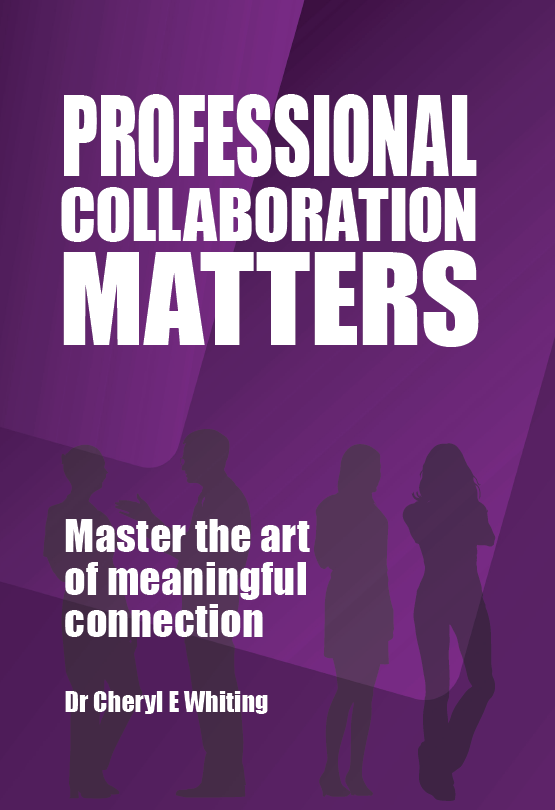
Dr. Cheryl Whiting’s upcoming work, Professional Collaboration Matters: Master the Art of Meaningful Connection:
Whiting argues that the greatest trap in modern professional ecosystems is the institutional pressure to quantify everything through metrics. When employees are reduced to data points, performance charts, or tasks on a screen, collaboration inevitably becomes transactional.
The Author’s Thesis: True collaboration begins when partners stop viewing each other as mere utility tools and start recognising one another as “whole individuals” working toward a shared goal. Building this connection requires cultivating an authentic and distinct professional culture that resists mere corporate superficiality.
The book deeply examines three critical layers that form the foundation of a sustainable, high-level partnership:
A. Suspending Assumptions (The Client & Peer Horizon)
As professionals, we frequently assume that our own definition of what is “right,” “efficient,” or “ethical” is universally shared. Whiting strongly challenges this:
We must actively acknowledge that individuals from different disciplines, cultures, or backgrounds view the professional landscape through entirely different lenses.
True collaboration does not begin by imposing our own framework; it starts with empathy—by listening to understand the underlying values and expectations of our peers.
B. Confronting the “Hidden Curriculum” of the Workplace
Drawing from her research in educational sociology, Whiting highlights the “hidden curriculum”—the unspoken rules and cultural pressures that operate beneath an organisation’s formal guidelines.
In most modern workplaces, this invisible framework relentlessly prioritises speed, short-term outputs, and blind efficiency.
The book demonstrates how this pressure erodes quality human interaction. Masterful collaboration requires consciously pushing back against this “race for speed” and shifting the focus back to a shared pursuit of excellence.
C. Excellence as a Transient State
One of the most striking philosophical points in Whiting’s work is that professional excellence and harmonious collaboration are never permanent achievements.
Excellence is transient. Much like an athlete who is only as good as their current performance, a professional is only as good as their current interaction.
Therefore, successful partnerships are not stagnant milestones. They are dynamic processes requiring continuous, active, and mutual investment in self-improvement.
Rather than viewing cross-disciplinary partnerships as a series of rigid “hand-overs,” the book treats collaboration as a shared intellectual and practical craft, offering several approaches:
Deep Listening and Authenticity: Communicating openly without hiding behind corporate masks, maintaining professional boundaries while preserving genuine human warmth.
Overcoming the “Good Enough” Trap: Accepting the status quo halts progress. As the author notes: “When we accept good enough, we impose limitations on ourselves and our expectations.”
Psychological Safety and Transparency: Whiting shows that teams capable of openly discussing mistakes and vulnerabilities—rather than maintaining an illusion of perfection—display far greater resilience during crises.
In an era where data and algorithms risk isolating the individual, professional success and institutional reputation rely heavily on the depth of our human connections. Collaboration is not a final destination, but an ongoing intellectual and interpersonal craft that must be practised every single day.
Copyright Professor Ethem Güneren, 2026 – shared with permission
By Anne Wilson, May 2026
I’m delighted to have been invited to write the foreword to Professional Collaboration Matters, Dr Cheryl Whiting’s latest and timely book. As someone who has worked in leadership roles within Higher Education and local government, and more recently as a freelance trainer and career coach, I have skin in the game. I’ve experienced both fruitful collaborations and some less-than-ideal scenarios. When collaboration works well, everything flows. The contribution of each partner often exceeds the original project outcomes. Relationships flourish, leading to future opportunities and recommendations, and stakeholders are happy. Individual reputations are enhanced, and organisations enjoy the accompanying positive publicity. Most importantly, services to clients are enhanced.
I first met Cheryl in 2023, when she was in the process of publishing her first book, Professionalism Matters. Cheryl’s laser focus on the importance of the topic and the formal recognition she received through her Doctorate gave her gravitas on this subject. I knew she would apply the same depth of insight to the topic of collaboration.
The key message of Professional Collaboration Matters is that collaboration is a skill that anyone can learn. We all have the potential to collaborate well. Fundamentally, collaboration is a dynamic process. While knowing why you want to collaborate is key, so too are our behaviours and how we show up. While processes and structures matter, they can’t replace a lack of professionalism, values, emotional intelligence, and self-awareness.
Communication is key. Understanding and conveying your ideas, thoughts and hopes are important. Listening to your prospective collaborators equally so. There is no place for ego. Partners need to be equal in the collaboration dance. The most important goal of any collaboration is the impact on your mutual client.
When I reflect on the collaborations that went less well for me, Professional Collaboration Matters would have been an incredibly helpful resource to have had at my disposal. Cheryl undertakes a forensic analysis of what makes collaboration effective through her research into the experiences of others. By picking apart the requisite qualities, conditions, and processes, she enables the reader to increase the likelihood of fruitful alliances.
At the end of each chapter, there is a section headed ‘Points to Ponder.’ This encourages the reader to reflect on the different aspects of the collaborative process. For me, these reflective questions are what add unique value to the book. They are a very effective way, not only to absorb the key information contained in each section, but to engage in reflecting on the different ways you are personally engaging in collaboration. This is invaluable when considering, for example, why you might collaborate, how collaboration might benefit you and your business and how you’re feeling about the process.
From my own experience, I reflected that while I’m good at establishing effective working relationships with partners, detail is not one of my strengths. The opportunity to pause and clarify my hopes and expectations for all parties, including likely time commitments, would have been helpful to map out beforehand. This would have undoubtedly helped me close loopholes and avoid some friction once a project was underway.
Completing the ‘Points to Ponder’ systematically would have ensured I was better positioned to engage fruitfully with prospective partners. I would have been clearer about the purpose of collaborating, felt better prepared and approached prospective collaborators more professionally. By reflecting regularly, I would have appreciated what was working well and where I needed to pay greater attention.
The world of work is in flux. The advent of AI adds an extra dimension. Individuals and organisations are constantly required to explore more effective and efficient ways of working. Opportunities to collaborate will increase- whether out of necessity or by design. The most innovative ways to improve outcomes for clients often come from individuals who bring their complementary strengths and imagination together to solve problems and improve services.
Professional Collaborative Matters is therefore a most timely publication. It will help many more people become not just more effective at working in partnership, but also help individuals and organisations transform the way they work together.
Anne Wilson, SFHEA
Award-winning trainer, speaker, licensed Strengths practitioner and Firework career change coach.
Website: www.thecareercatalyst.co.uk
Copyright May 2026
Understanding the difference between training and development is essential for building a capable, adaptable, and future-ready workforce. In this blog, I explore how these two approaches serve different purposes, why both matter, and how they work together to support learning, performance, and long-term organisational success.

Training and development go hand in hand and are often used interchangeably, but they are in fact very distinct. Training is about developing targeted skills, deepening knowledge, and cultivating behaviours essential to immediate performance in a current role. That means it is likely to be short-term, task-specific, and scheduled; often a one-off event or a short course, that provides information or practical know-how. Good examples would be a mandatory health and safety or compliance briefing, instructions and guidance on implementing a new procedure, or a workshop that teaches staff how to use a new computer software package.
Development, on the other hand, supports longer-term growth through hands-on experience. The focus is therefore on developing future potential, enhancing capabilities, and fostering good practice and professional maturity. Development is less about teaching and more about continuously supporting individuals as they work to achieve their personal aspirations and build a range of competencies and mindsets that prepare them for future roles with greater responsibilities. This might include activities such as job rotations, leading a quality improvement project, or preparing someone, through professional qualifications and peer mentoring, to take on a leadership role or a specialist position within your organisation.
Training facilitates consistent performance and operational growth. Development supports strategic growth and succession planning. It prepares businesses for future challenges by building a talented pool of team members who not only perform tasks competently but are also ready to support business growth and assume alternative, or more complex, larger roles, ensuring the business remains competitive.
To put it simply, training sharpens capability while development transforms potential and generates commitment. Their distinctiveness necessitates different resources, operating within varied timelines, and requires us to hold separate expectations. Knowing the difference ensures that time, effort and money are channelled into the right solution, depending on whether we want to address a skills gap or a growth gap. Different goals require different teaching, learning and support methods, and to get the right outcome, we need the right approach. It’s important to recognise that creating a successful and sustainable business requires purposeful, ongoing training and development. While demands may vary, there will always be an immediate need, upcoming challenges, and new goals to pursue. All of which influence strategic direction, required investment, expected performance and organisational strength.
Together, training and development create conditions for learning; the three are inextricably connected. In short, learning is an internal process in which gathered information becomes understanding, whereby perspectives change, and skills are enhanced, so that, as individuals, we think, act, and behave differently in everyday life. Training enhances short-term performance, learning facilitates practical application, and development improves long-term capabilities. Collectively, they enable growth, application, and personal, professional, and organisational progress.
Well-designed, engaging training creates the conditions for learning, but, on its own, training is unlikely to generate long-term change in confidence, behaviour or performance. Not everyone learns the same way, and information and skills can quickly fade, which brings the need to build retention through repetition and practice. Learning needs to continue long after training ends. It needs to be reinforced so that employees can acquire further knowledge, apply it to everyday working practices and business activities, and gain additional support to further enhance confidence, adapt to complexity and nuances, and become more independent. It is only through experiences accumulated over time that performance improves and development occurs.
In almost every aspect of work, there is a learning opportunity in every experience, interaction, challenge, success, or mistake. What this brings is the potential for everyday work to be an opportunity to introduce knowledge, refine skills, deepen understanding, build judgment, and strengthen confidence. If we can do this, learning, training, and development reinforce one another rather than operating in isolation. Learning becomes less of an event and more of a continuous cycle. Yet to achieve this, coherence is essential; only when the right systems, processes, opportunities, and environments align does knowledge become action.
Growth is directly shaped by the quality of the training and development experience, as well as the levels of support, resources, and investment. It is only by spotting learning opportunities, clarifying ideas and actions, and making the training and development journey easier and more predictable that a vibrant culture of learning can be created, turning knowledge and skills into long-term success.
In the end, effective organisations do not simply train people to do today’s job—they also develop them for tomorrow’s opportunities. When training, learning, and development are aligned, businesses can improve performance, strengthen capability, and create lasting growth without wasting time or resources.
Thank you for taking the time to read this article, which forms part of a blog-to-book journey. A project designed not just to inform, but to generate conversation and engagement in my third book, “Train Better: Spend Less.” A practical toolkit for business leaders committed to cultivating professionalism through ongoing staff development, even when resources are stretched to their limit. If you’re keen to build a professional workforce that’s astute and adaptable, stay tuned; more insights and creative ideas on how to make the best use of existing resources are coming.
As always, your thoughts and feedback are welcome. Whether it’s a question, a shared insight, a suggestion for improvement, or a request to cover a particular topic in my blog series, please do get in touch.
Written by Dr Cheryl Whiting, EdD, © May 2026
New employees arrive with varied backgrounds, levels of training, and different interpretations of what “good” looks like. By assuming new staff already know the ropes, we unintentionally create confusion and inconsistency, and preventable mistakes. This article explains why we must ensure that competence is built, checked, and supported rather than presumed.

Employing the right people is critical to business success. During the recruitment and selection process, many of us thoughtfully evaluate each candidate to see how well they meet our selection criteria, which highlight a key set of competencies. As a result, we feel confident enough to appoint the candidate who has demonstrated the right values, attitudes, and skills and appears well-equipped to succeed in the role.
Hiring new personnel is full of uncertainty, yet by making an appointment, we often assume that previously acquired skills and competencies will continue to be applied appropriately, that possessing specific competencies signifies competence, and that competence is synonymous with professionalism.
Such assumptions can lead us to reduce the time and resources devoted to employee induction and progress monitoring, as well as the level of support and training provided. This can have detrimental consequences, leading to errors and reducing our new employees’ ability to meet expected standards, thereby affecting our business’s reputation and subsequent growth.
To understand why it’s wrong to assume competence, it’s important to appreciate just what competence is. Although there is no universally accepted definition or shared understanding of competence, it is mainly considered an observable combination of vital knowledge, skills, and attributes applied to perform effectively in a specific role.
Each employee has a distinctive combination of capabilities acquired through education and work experience. The possession of this essential knowledge, skills, and attributes represents competencies; the mere possession of a set of competencies is not an indication of competence.
Competence relates to an individual’s ability to draw from their range of competencies and make appropriate value-based judgments to handle situations and tasks. Competence is thus grounded in the ability to integrate and directly apply these competencies within the context of a professional role.
Across professions and industries, many models of competence exist, and many organisations develop their competency frameworks, which map out the relevant knowledge and skill sets required, alongside the standards necessary to fulfil roles and responsibilities. Such frameworks represent a continuum of advancement from ‘novice’ to ‘expert’. Competency is, therefore, a variable concept that represents distinct requirements at various stages of employment and is often associated with professional grade, level of seniority, etc. Consequently, the achievement of competence defines progress and personal development.
Achieving competence is complex; it relies on people gaining experience and becoming familiar with practice standards until they can perform effortlessly. This requires individuals to bring several aspects together and make it part of their habitual practice.
Individual staff members can often overestimate their competence, particularly when they have yet to experience the realities of the work they are employed to do. We live in a world of constant change, and this is an important consideration when making judgments about competence, because it is often assumed that skills learned and applied effectively in one context can be readily applied in another to generate the same outcomes. To meet the requirements of the job, new employees will need to unlearn, learn, relearn, adapt, and refine their values, attitudes, and skills to successfully perform in their new roles and fulfil their responsibilities.
It would be remiss of us to invest in the recruitment and selection process only to assume that new employees are fully capable of meeting the job requirements. Development and attainment of competence are dynamic processes that require regular review to safeguard the quality of work, safety, collegial relationships, and the level of professional service provided to clients.
Developing competence can be attributed to good induction, systems of appraisal, ongoing training, and supportive work-based supervision that are built in appropriate ways to enhance and establish levels of competence. Monitoring progress and assessing competence are more complex and not without problems, often relying on assumptions that overlook the complexity of practice. This is especially important because we should avoid reducing competence to just observable behaviour and outcome, without paying attention to the reasoning, ethics, and values that motivate actions.
The combination of a well-designed primary induction programme over 4-6 weeks, supported by a competency-based framework for guidance, will create a process to assess and monitor competence, considering skills and professional behaviour, and gather evidence of how, for example, ethics, personal and practical wisdom, problem solving, and creativity are incorporated and demonstrated in professional roles. Together, they reveal professional and personal strengths, missing skills and qualities, and uncover support needs. If we provide relevant training and regular check-ins to gather evidence of progress and performance feedback, we do not have to second-guess the level of competence or professionalism.
As employers, we need a competent workforce to develop and deliver high-quality products and services. Competence is shaped by education and training, and investing in these areas leads to greater efficiency, higher job satisfaction, and better employee retention. By making premature assumptions about competence, we can inadvertently fail to support the transition into the workplace. Empowering new employees to acquire new skills, strengthen existing skills, and enhance their capacity to consolidate and exemplify their competencies to others makes sense for establishing good standards of practice and ensuring quality outcomes.
For a business to succeed, the people within it need to succeed; competence and performance are inexorably linked. Assuming new employees are competent is risky; overreliance on the recruitment process alone can lead to costly errors and missed opportunities for growth. For success, competence needs to be continually cultivated and measured.
Our own judgement may be trustworthy, but we leave our organisation vulnerable if we do not test our judgement. If we want assurance of our new employee’s competence, we need to examine our induction process, its aims and purpose. We can either feel reassured that we haven’t underestimated competence or implement supportive interventions to help individuals develop essential skills and use them effectively.
With the right structures in place, we can stop assuming because clarity replaces guesswork, such that competence becomes what we can see, support and strengthen. Clarity facilitates the alignment of capabilities when we have competence by design rather than by assumption; we increase the likelihood of sustainable business growth.
Thanks for reading this article. It is a short excerpt from material that forms part of my current blog-to-book project, Train Better: Spend Less, which helps employers achieve staff development even when budgets are tight.
As always, your thoughts and opinions on this piece and any of my articles are welcome and graciously received.
© Dr Cheryl Whiting – April 2026
Workplace training falls into two categories: on-the-job experience or formal classroom-based learning activities. Together, they offer a comprehensive approach to development, enabling employees to gain the right knowledge and practical skills to perform well and grow in their roles. External training offered by experts is often seen as more official and higher quality, although this is somewhat of a misconception. It is also not the most efficient method for building capability, as it is rarely tailored to individual staff development needs and can be expensive, quickly depleting available budgets.
In most cases, training delivered internally is much stronger. The powerful impact the working environment has on learning and development should never be underestimated. To overlook this significance risks disregarding the valuable lessons each colleague can share and the growth that results from everyday observations, interactions, and practical, hands-on experience.
Nor should we underestimate the complexity of the roles we require staff to undertake, or the sophisticated skills needed to perform them effectively. Each task requires a mix of technical, practical, cognitive, and behavioural skills. To execute their roles, staff will need to draw on knowledge of organisational policies, processes, procedures, internal systems, workflow patterns, industry-specific regulations, professional expectations, and a broad understanding of our occupational sector. When we examine these requirements, it becomes clear how skilled our staff must be to operate effectively and ensure the business continues to run.

Competence, productivity, and confidence increase not only from the theoretical knowledge staff may gain through qualifications, short courses, or workshops, but also from practical experience and immersion in our organisation’s culture. Formal learning is great for understanding the specialist knowledge underpinning practice, but it is fairly limited in preparing staff to deal with the realities of context-specific working life and the challenges it brings within a unique organisation. No formal training can fully replicate the lived experience that comes with doing. Action and day-to-day encounters provide the context that makes formal learning meaningful, relevant and applicable.
Professionalism and proficiency stem from adaptability and ongoing learning. Expertise develops through consistent practice, collaboration, and learning from errors—fostering good habits, work ethics, emotional intelligence, efficient time management, attention to detail, accountability and a dedication to quality and customer service.
If we count ourselves lucky enough to have staff who display these attributes, then we have a wealth of practical knowledge and experience that is a valuable resource. By recognising and harnessing this internal wisdom and expertise, we can unlock significant potential for developing both new and existing team members, making our business stronger, more capable, productive and efficient.
Existing staff make the best trainers, simply because they have done the job themselves and understand what works and what it really takes to do it well in various situations. However, we risk wasting this potential without the right support, structure and recognition.
To help us make the most of our talented team, this article shares important considerations, explains why they matter, and offers simple action steps to support ongoing staff-led training.
Training doesn’t have to come from one expert. The most effective collaborative environments are built on people sharing what they know well, what they are good at, be that a technical skill or a process they have mastered. Every member of our team will have their own strengths, possess specialist subject knowledge, or be adept at learning new things and happy to share so others become more proficient and remain up to date. By identifying team members’ strengths, we can assign specific training responsibilities, such as instructional roles, workshop delivery, or peer mentoring. This allows our staff to learn from experts while staff trainers engage in roles they are comfortable with.
As well as being effective communicators, trainers need to be positive role models who can push themselves and others beyond their comfort zones in order to grow. If we want new or existing staff to copy what they see, what they see needs to be worth copying. Good role models build trust by consistently demonstrating their values and integrity through their words and actions. As a result, team members are less likely to develop bad habits, poor communication styles, or negative attitudes. When trainers exemplify professionalism, other staff will also strive for excellence and support each other’s development, ultimately raising the overall standard of the team and organisation.
Just because people excel at their job doesn’t mean they are automatically effective at training others; that does not imply their skills are wholly inadequate or can’t be enhanced. Staff who take on training roles will need some training themselves, but not in the way people assume. They don’t need to become professional teachers, but it’s important that they receive support to share their expertise: to transfer knowledge clearly, break things down, assess performance, provide feedback, and support diverse learners.
Invest in training trainers. Good external training can elevate the skills of many within your team. Better trainers result in improved learning experiences, performance, and outcomes. Since most on-the-job training falls into the category of microteaching, which is characterised by short, focused bursts of formal instruction or practical guidance embedded within day-to-day practices, it is possible to support trainers without formal courses by using a simple framework that defines objectives and offers strategies for constructive, facilitative actions and feedback.
Being skilled doesn’t mean people are willing to train others. Reluctance often isn’t about laziness; it usually stems from a lack of confidence or capacity to take on anything else. Perceptions of having no time are often based on mistaken assumptions that there will be an expectation to fulfil the training role within existing schedules without any workload adjustments. Our strategy here must be to remove barriers and create a culture that legitimises, protects and values learning and development, ensuring staff can ring-fence time to step away from their roles to prepare and deliver training. If training responsibilities are perceived as an added burden, both the quality of work and the quality of training quickly decline.
The most capable individuals are often the least confident when it comes to training others. Imposter syndrome is common, believing there is more to know and that others know more, which leads potential trainers to question whether what they know would be of value. The thing is, once individuals become competent, many skills become automatic, and they forget what they know and what drives their actions and decisions. Everything becomes natural, and with that, they underestimate how much expertise they hold. Individuals lacking confidence often interpret being asked to adopt training roles as a sign of others’ unwillingness. Part of our job here is to build and reframe the narrative by reinforcing the value of their expertise and contributions through their competence.
With multiple trainers, training standards can vary. The impact on trainees is mixed messages, inconsistent expectations, and habits that don’t align with organisational standards or safe practices. To achieve quality, safety and consistency, we need to ensure that trainers receive clear guidance on what should be delivered, which standards to follow, and the outcomes, behaviours and development we wish to see in staff after training is complete. However, differences in expression, creativity and style of delivery need to be accommodated and celebrated, for they add value to the learning experience. It is often through these that engagement, innovation, responsibility, and ownership of the training role arise.
No training should take place without support or recognition; we can’t sit back and expect staff to get on with it. If we want to see results, that means we must invest in the process and actively support trainers by offering time to prepare and organise their approach. It is through guidance, resources, and opportunities to practice that skills are refined and training confidence and competence are established. We need to stay informed and seek feedback; this is the only way to understand what is happening, what works, what doesn’t, and what needs to change to achieve our goal of building a knowledgeable, competent, and professional workforce. Moreover, it enables us to understand the effort individuals put in, so we can acknowledge this in a meaningful way by celebrating success, rewarding excellence and encouraging continuous improvement. This significantly helps individuals feel appreciated, motivating them to contribute more fully to training and development.

By encouraging staff to share their knowledge and experiences, we can create an environment where learning and development are part of the norm. People tend to feel more at ease when learning from colleagues they know and trust, especially those who have hands-on experience in the role they are expected too are expected to undertake. Trainers who genuinely understand the job and its nuances relate better to the trainees’ experiences, which not only boosts psychological safety but also ensures that training is grounded in real-world practice. This familiarity encourages open dialogue, questions, honest feedback, and practical guidance, making the learning and development process more effective, supportive, and conducive to continuous improvement.
Enhancing interactions and engagement in training boosts employees’ sense of value and belonging. When we recognise and value ability, trust our employees to train others, and remove barriers and provide structure, they gain confidence in their ability to facilitate learning and development, ensuring knowledge is transferred effectively. With active involvement, confidence grows, and connections to our organisation and the team are strengthened. This not only drives motivation and job satisfaction but also supports long-term development and retention. Creating a training culture where everyone’s contribution matters is win-win for development and loyalty.
Delivering training creates simultaneous opportunities to broaden knowledge and expertise. In helping others learn, staff are also honing their own abilities. When we teach others, we deepen our understanding of the subject; moreover, it forces us to confront what we don’t know. To engage in the process, our trainers must listen more, read more and answer questions. In facilitating learning, they build skills that will, for example, shape their emotional intelligence and leadership capacity. The process creates a culture of continuous improvement and encourages everyone to stretch themselves. Through this, we strengthen our organisation’s internal capability and build a workforce prepared for future innovation, business growth, and external challenges. It might surprise us to learn that as we support our trainers’ growth, we’re also nurturing our own personal development, forging stronger connections, and helping create a transformative culture.
Using existing staff as trainers is not only cost-effective but also makes ongoing training sustainable. Relying on internal staff allows us to offer ongoing development opportunities without the costs and logistical difficulties of external training providers. This approach leverages existing expertise and helps embed learning into everyday practices, making it easier to adapt training to the team’s evolving needs. This comes with a caveat: it is only cost-effective and sustainable if trainers are well-trained, mentored and supported; otherwise, the developmental changes we hope to achieve are unlikely, posing risks to clients, personnel, and our business. If we then need to pay for external trainers or repeat training due to insufficient support or less effective guidance and delivery, it might not be very cost-effective.

Assess skills gap, training and development needs. Consider the most needed skills within the organisation and industry and focus on areas where upskilling will have the greatest impact, even if training is provided to only one or two staff members. Conducting a skills audit to identify gaps in the team’s knowledge or abilities will help clarify areas for development and highlight opportunities for in-house training. Aligning skill development with organisational priorities and business goals will ensure that training is relevant, targeted and effective.
Consider the most effective approach to addressing these training needs. Evaluate the extent of external training support needed for all or part of this, if at all. If opting to keep training internal, determine the most suitable approach: a classroom-style workshop, a tutorial, shadowing, mentorship, hands-on experience, or a combination of these. Consideration will need to be given to the overall duration of the training, when it should take place, how it will, if at all, impact operational activities, and when you expect to see results, bearing in mind that some skills require time to develop through practice.
Consider the resources and budget allocation. Training is not without cost; there will always be some minor costs associated with delivery, and these need to be calculated to ensure they fall within the available budget. Nothing happens without the right resources, whether that is the number of personnel needed for training, physical space, learning and facilitation materials, technology, or other equipment. Identifying these early ensures that resources can be bought, obtained or accessed, making training possible and effective.
Identify which team members already have the knowledge, experience, or strengths needed to deliver training. Mapping current skills and strengths using personal insight and performance data helps identify both those already capable of being effective trainers and those with the potential to become trainers. Focus on practical capability as well as attitude. Staff who consistently demonstrate positive behaviours, strong communication, and professionalism will naturally set the standard for others and can lead by example. Don’t forget to look beyond job titles and length of employment; entry-level staff and newcomers can be a source of inspiration and innovation. They often arrive with a sharper sense of evolving technology and industry trends.
Engage in open conversations with staff about their abilities, interests, and what they enjoy doing. Conversations reveal a lot about perceived strengths and willingness to participate in training. Such discussions often uncover hidden talents, motivations, career aspirations, and the true extent of workloads. Useful information that helps ensure that training facilitation roles align with personal preferences and empowers employees to take ownership of their development, ultimately enhancing engagement and effectiveness without burning anyone out. Training, whether leading it or participating in it, should always inspire and energise, and never drain.
Give clear guidance and support. Work with trainers to ensure training content, methods, and expectations align with organisational goals and safe practices, reducing confusion and promoting quality outcomes. Develop guidance on what trainers should do, how much time they should commit, and what outcomes are expected. Defining expectations ensures consistency, standardisation, and repeatable quality. This way, trainers are not guessing what to include and can focus on delivering a brief that showcases their expertise, creativity and facilitative skills. Moreover, clear guidance and standards make it easier to evaluate learner progress and trainer effectiveness, thus supporting continuous improvement in training delivery. Be sure to follow up with trainers to give and receive feedback, explore development opportunities, offer recognition and guide them towards any support they might need. Open conversations help us solve problems more quickly and ensure we provide support right when needed, keeping training standards high.
Establish robust mechanisms for monitoring and evaluating training effectiveness. Training should always have a clear purpose, but without evaluation, it becomes just an activity rather than an opportunity to assess subsequent development. Evaluation provides a means to assess quality and outcomes, as well as further development needs. Training often reveals other areas for improvement. This valuable information can be used to shape and enhance future training plans. Evaluation doesn’t have to be a complicated activity; a simple survey or reflective conversations can offer insight into skill development, increased confidence, and competence.

If we can empower staff to take an active role in training, it not only boosts individual confidence and skills but also enhances the organisation. By aligning business goals with a needs analysis and investing in clear guidance, open conversations, and ongoing support, we can cultivate a culture of continuous improvement, collaboration, and innovation. This creates a strong foundation for a successful staff-led training programme that motivates and uplifts everyone involved, including ourselves. Ultimately, when everyone is encouraged to grow and share their expertise, both personal development and organisational success are secured, making staff-led training an effective, sustainable and cost-effective way to achieve our business goals and objectives.
This article is part of a blog-to-book journey—a project designed not just to inform, but to generate conversation and engagement in my third book, “Train Better: Spend Less.” A practical toolkit for business leaders committed to cultivating professionalism through ongoing staff development, even when resources are stretched to their limit. If you’re keen to build a professional workforce that’s astute and adaptable, stay tuned; more insights and creative ideas on how to make the best use of existing resources are coming.
Thank you for taking the time to read this article. As always, your thoughts and feedback are welcome. Whether it’s a question, a shared insight, a suggestion for improvement, or a request to cover a particular topic in my blog series, please do get in touch.
Written by Dr Cheryl Whiting, EdD, © April 2026
Hello and welcome to the first instalment of my blog-to-book journey—a project designed not just to inform, but to generate conversation and engagement in my upcoming third book, “Train Better: Spend Less.” A practical toolkit for business leaders committed to cultivating professionalism through ongoing staff development, even when resources are stretched to their limit. If you’re keen to build a professional workforce that’s astute and adaptable, read on and stay tuned; more insights and creative ideas on how to make the best use of existing resources are coming.

The question on my mind this week is: Why do good intentions around training and development so often fizzle out?
Most of us would agree that training and development are very important.
It’s clear to us all: knowledge quickly becomes outdated, and skills fade or lose their relevance over time. Every day, we see how qualified, trained staff work productively and confidently, make fewer mistakes, and keep accidents and compliance issues at bay.
We know that if staff don’t remain sharp and adaptable, we risk getting left behind as the world races ahead. We also worry that our brightest, most innovative, and loyal team members may be drawn away by more inspiring opportunities elsewhere. A nightmare that strikes at both our hearts and our pockets.
With all this in mind, it’s obvious why training matters. Yet, unless it’s mandatory or lives depend on it, training rarely feels urgent. So, while we wholeheartedly believe in its value, all too often, it’s pushed to the bottom of the pile.
The very thing we value is often sacrificed.
This is not because we don’t care, but because the relentless pace of daily tasks, ingrained workplace habits, and financial pressures push it further down the list of priorities. As a result, training slips quietly into the background, overshadowed by everything else demanding our immediate attention.
With urgent deadlines looming and targets to meet, training becomes the thing we’ll get to when it’s quieter—but these moments never arrive. Taking staff away from their desks for personal development feels almost impossible when every pair of hands is needed, and finding cover or creating downtime is a juggling act few are willing to attempt.
Then there’s the classic “if it isn’t broke, don’t fix it” mindset. Unless staff are struggling, it’s tempting to believe yesterday’s approach will also see us through tomorrow. But that attitude can hold us back and allow us to pretend there is no need for improvement.
Even when we recognise there’s scope for enhancement, the real challenge lies in overcoming the capability gap by finding and shaping training opportunities that genuinely feel like personal and professional growth, not a box-ticking exercise or remediation.
Nor can we ignore the elephant in the room: training costs money, and its benefits aren’t always clear-cut. Measuring success or impact can be tricky, and without obvious results, it’s hard to justify the investment. Worse still, training can be uninspiring, generic, or poorly organised; it’s no wonder we doubt its ability to meet our business needs and drive the change and growth we hope for.
The key issue is that although we say training is valuable, our actions often paint a different picture, as we let practical challenges and ingrained behaviours push it aside.
So, what is it about our own circumstances that creates that gap?
The response to this question mainly depends on where we place ourselves on the spectrum between valuing training and development, creating room for it, and dedicating adequate resources to it.
This is not intended as a judgment but rather as an honest check-in.
Training and development, of course, come in many forms, whether it’s formal, classroom-based instruction, practical on-the-job training, or social, collaborative mentorship. A lack of training and development is not without reason. If we can identify our position and understand the root cause, we can begin to address the issue.
The answer gives us a starting point for deciding what needs to change, what support is needed, and which conversations are needed to move forward with a training and development strategy that closes the gap between intention and action.
Our approach to training and development should not focus solely on providing more training; it should ensure that the right skills are developed in the right people, at the right time and in the right way. Any training, whether delivered internally or externally, needs to be purposeful, targeted and aligned with our business needs and the personal and professional development we want staff to achieve.
What matters is that we find ways to prioritise staff development. This sends a clear message that staff potential is valuable and that our business is dedicated to thriving in a fast-paced environment. The journey will almost certainly require commitment and changes to habits, but the rewards—greater engagement, creativity, future success, and stability—will be worth it. It is often through small, manageable steps that we achieve our business goals: Training and development is no different. We see real changes in staff skills and a culture that values learning when we close the gap, and that gap is almost always closed through steady, intentional growth.
The question is: Are you ready to turn training and development into something you do, not something you promise?
If so, connect or follow me on LinkedIn for updates and articles focused on making ongoing training and development a reality through the optimal use of resources.
Written by Dr Cheryl Whiting, EdD, © March 2026
Thank you for taking the time to read this article. As always, your thoughts and feedback are welcome. Whether it’s a question, a shared insight, a suggestion for improvement, or a request to cover a particular topic in my blog series, please do get in touch.

February 2026 marked the completion of the first draft of my second book, Professional Collaboration Matters, a sequel to Professionalism Matters, published back in 2023. I cannot believe that I have written ‘the end’ for the second time. The material is by no means perfect, but over the coming months, I’ll be collaborating with editors, proof-readers, and publishers to bring this manuscript to life as a book.
I didn’t originally plan to write two books, but once I started writing, my mind kept generating new ideas. Having begun a literary conversation with Professional Matters, I felt compelled to keep it going, largely because there was so much more left to be said. Furthermore, having bumbled my way through writing the first, I thought it was only fair to have another go, applying what I had learned in the hope of refining my skills, just to be sure success was down to talent, not luck.
As I begin exploring ideas for a third book, I feel that the decision to keep writing isn’t so much a conscious choice as a quiet, inescapable pull towards another book, for reasons I’ll explain below.
Professional development is a topic that refuses to shrink
Having spent the best part of my academic career researching concepts of professionalism and exploring its impact on training, personal development, client satisfaction and outcomes, I thought I knew all there was to know about the subject, but clearly, I was wrong.
Professionalism Matters aimed to blend my academic insights with the real-life experiences of business owners. While interviewing such individuals about building strong client relationships, enhancing credibility, and establishing a positive reputation through professional practice, it became clear I was only scratching the surface. Conversations revealed that building and maintaining strong relationships with collaborative partners were just as important, but required a different set of skills, attitudes, and values. Professionalism remained central, but it appeared and felt different in the context of sustaining shared endeavours and securing long-term collaboration partnerships.
It was a fresh angle, a different theme that invited new questions and a deeper exploration of experiences. Since more detail and more examples would be necessary, the subject of professional collaboration seemed deserving of its own book. Those I interviewed, unknowingly, were already shaping my second book and guiding me towards putting pen to paper.
This wasn’t quite what I expected. I had hoped that after finishing the first book, I could finally sit back and relax, but it turned out to be the opposite. Suddenly, I found myself holding others’ thoughts and perspectives that would probably never come to light unless I articulated them, things I hadn’t even realised needed sharing until that moment. My interviewees were setting me off on a different intellectual journey, giving me a new purpose, so I couldn’t stop the bus even if I wanted to.
Writing develops you into a writer
Nothing prepares you for writing a book more than writing a book. The more you write, the more writing a book becomes less of a project and more of a way of life. My first book was really a warm-up act, a kind of apprenticeship, in which I learnt to write. More than this, I was able to recognise my habits, strengths and weaknesses, discover my creativity, find my voice, make mistakes, practice, and improve my skills. Between the first and the last words, a different writer emerged, who knew how to sustain momentum to create a book worth reading.
The act of writing changed me. By the end of book number one, I was no longer a novice. I had become more efficient and disciplined, confident that, by writing again, I would start from a place where I could refine processes, deepen my understanding, shape my voice, and sharpen my skills to craft a much stronger book.
Writing has become part of my identity
Writing becomes a way of thinking, and thinking naturally leads to writing. Writing for three hours each day is more than just a task; it’s now a fundamental part of my life. Writing has become a habit, and one that I’ve come to realise I love, mainly because writing expands my perspectives, skills, and ambitions, enriching the overall experience. It is a practice that fulfils me, reinforces my belief that my voice matters, and moves me closer to becoming the accomplished author I aspire to be.
Essentially, my first book was an exciting intellectual adventure that led to a second one built on ideas and lessons from the first, yet it is my growing confidence as a writer that motivates me to pursue a third.
The mix of experience, learning, and confidence has changed how I see myself
I am no longer just someone who writes, but a writer. I’ve learned to trust my ideas and voice, which gives me the confidence to pursue a new creative challenge that adopts a very distinctive approach, which until now didn’t feel possible.
In my earlier work, interviewing people made perfect sense; I was using their thoughts, ideas and examples of practice to strengthen my own point of view. The time is right to try something different, and instead of collecting others’ voices, I’m going to reclaim my own. For my third book, I will return to my core expertise: vocational education and training. As an educator, I am already sitting on work that deserves a second life and a coherent narrative. So, with a working title of ‘Train better, spend less’, it will be a book that draws on decades of personal knowledge and experience to help businesses maximise opportunities for staff development, even when budgets are tight.
Early days yet, and ideas are still embryonic; nonetheless, I’m going to take the brave step of making this a living project by adopting a blog-to-book approach. If there is one thing I wholeheartedly appreciated about my first two books, it was sharing the journey with others. My interviewees certainly kept me accountable and connected, offering encouragement and valuable feedback along the way. Not wanting to lose all that keeps the momentum going, I’m turning book number three into a shared journey through regular blog posts so everyone can follow my progress, comment, and apply what I am sharing without waiting until the end of the book.
My books are not just ideas and words; they are a journey of personal growth and discovery
A blog-to-book approach seems like a perfect way to share my progress and creativity, whilst changing practices and inspiring others. If you have ever felt the urge to share your story or feel you have a book in you, that’s just waiting to be written, then I encourage you to follow my lead. If you’re looking for further guidance and motivation, then do check out my blog “Thinking of writing a book? Here are 5 top tips to get you started.”
Regardless of your interest in professional development or writing, stay tuned for updates on my new writing adventure and the publication of my second book, Professional Collaboration Matters (out soon!) If you haven’t yet checked out Professionalism Matters, click here and find out more.
Here’s hoping as my journey continues, yours begins.
As always, your thoughts and comments on anything I write are most welcome, so please do contact me.
For all businesses, whether product- or service-based, acquiring new clients in a competitive market is tricky; retaining them can be even more challenging. And yet, loyal clients minimise financial strain, increase revenue, enhance our reputation, and create a highly influential fan base that attracts new clients. Client loyalty is a key factor in our success, so it is essential for us to explore ways to nurture it.
Click the link below to read more about how our core professional values significantly impact client retention and business success, and why they matter. An article first published in SME Today: April 2025
