Over the past couple of years, I’ve been slowly reinventing myself as a writer. Writing was very much part of my academic career, but academics write to inform peers, often to prove a point, whereas authors write to engage people and guide readers on a journey. In achieving the latter, I was under no illusion that this meant I needed to relearn how to write to make my ideas more accessible, less formal, and more conversational to reach my intended audience, i.e., freelancers, solo entrepreneurs, startups and small business owners.
Writers are often told to write what they know, and I thought I knew a great deal about professionalism and working relationships that underpin it, having researched it for over 20 years. But the moment I began writing my first book, Professionalism Matters, I came to the realisation that what I thought was solid knowledge turned out to be a collection of assumptions I’d never examined outside of the context of health and social care.
So, I began gathering ideas from people in my business network, looking for real‑world examples that would help me express my ideas more powerfully. My readers loved this approach, and it proved its value. So, it made perfect sense to use the same method for my second book, Professional Collaboration Matters. After all, you can’t credibly write a book about collaboration without collaborating.
I approached this book with the confidence of someone who’d done it before, only this time, because I was writing about collaboration, I became far more attuned to how it unfolds. The subject forced me to live the process, not just write about it, which made the work feel more personal and relatable.
In both books, I stayed true to my writing style and research methods, but the conversations I had transformed the work. The process didn’t change, yet the people I spoke with changed the book and, in many ways, changed me too.
Firstly, other people’s insights and viewpoints introduced ideas and themes I had not previously considered.
This information challenged my assumptions, redirected me, opened new angles, and meant I began writing in response to questions different from the ones I had started with. Sharing discussions expanded my perspective, clarified my approach, and sharpened my reasoning. This not only influenced the book’s structure and content but also transformed how I thought and presented examples.
Writing became an iterative rather than linear process; chapters evolved as insights emerged. The book became far more nuanced, shaped by others’ broader insights, making it possible to situate it within a business context. Through shared thinking, I not only gained good ideas but also developed better ones that transformed my writing skills, the book’s nature and relevance.
Secondly, those I interviewed believed in me long before the words were on the page, and that trust deepened as the process went on.
Interviewees shifted from being sources to being contributors. Our shared intelligence advanced the work from a personal goal to a shared ambition, fostering a stronger sense of mutual respect and collective ownership.
Embracing others’ perspectives raised the standards I set for myself. When individuals shared their experiences, confided in me and entrusted me with their viewpoints, it inspired me to pursue higher aims. I became accountable to my contributors, which heightened my level of investment in the work. For example, I made a more conscious effort in my preparation, listened more attentively, and became more curious and productive. And, knowing I would be seeking their honest feedback as I shared completed chapters with them, I behaved with more humility.
What was interesting was that once people saw their words reflected in my writing, the relationship shifted: they were no longer outside the process but very much part of it. Contributors engaged with and invested in it because they began to value my strengths, as reflected in the quality of the output. With a clear sense of what it takes to write a book, contributors increasingly trusted my ability and championed my work. As a result, they dedicated effort to help me overcome setbacks, strengthen my resilience, ensure its success, build momentum, and create a community in which contributors took an interest in one another.
Thirdly, as feedback sharpened my thinking and approach to writing, the process of reading chapters similarly prompted growth and change within my contributors.
For many, reading not only validated existing good practices; it also led them to acquire new knowledge and gain insight into alternative perspectives, prompting them to reflect and set out on a course of action towards more effective ways of being and collaborating. This was great because it shows me that the book is doing what it is intended to do. Not only was it informative and inspiring, but it also promoted change in attitudes, values, and behaviours.
In essence, Professional Collaboration Matters moved from a solo project to a living, breathing, shared, and creative collaboration that didn’t just produce better work; it produced better versions of ourselves.
That journey reflects the book’s core message: Collaboration changes our mindset, our behaviour, our attitudes, our relationships, our system, our productivity and efficiency, as well as our confidence and ambition.
Collaboration makes us more intentional, focused, strategic, accountable, disciplined, and adaptable. It allows us to stretch ourselves mentally and creatively, so we move from thinking about ideas to thinking of possibilities. Through it, we learn to build and navigate relationships and to develop patience and perspective. It encourages us to invest in each other’s growth and empowers us to embrace change, manage risks, and seek support.
Ultimately, collaboration is a developmental journey that transforms us into professionals who are not only more skilled but also more connected, capable, and confident, enabling us to work together with greater impact and accomplish great things that make a difference to others.
However, that is just part of the story, because collaboration is not just about the tangible benefits. It is underpinned by processes and relational dynamics, which is why Professional Collaboration Matters was written. Our level of professionalism throughout the process determines development and outcomes.
Working towards shared goals, creating something of value that enables collective growth and success, starts with building strong relationships. Professional Collaboration Matters exists to help us do just that. At the same time, the book enhances our understanding of how collaboration works, clarifying the role of each stage in the process and how these stages contribute to sustainable business growth and success. It also highlights our part in this process through the attitudes, values, and behaviours we adopt, which influence working practices, shared expectations, and standards. This understanding enables us to contribute effectively within a world that is often complex and rapidly changing.
As a book, Professional Collaboration Matters stands as both a definitive guide to business collaboration and a testament to the power of collaboration itself.
Copyright- Dr Cheryl Whiting – July 2026
Written by Professor Ethem Güneren, Turkey
The piece below was written by a former colleague after reading my book.
For several years, I held the position of Visiting Professor at Bezmialem Vakif Universitesi in Turkey. An appointment in recognition of my sustained commitment to international and cross-cultural collaborative endeavours between this organisation and the university and medical school where I was employed at that time.
I keep in touch with many of my colleagues there, and, to my surprise, I received this detailed précis of my new book, Professional Collaboration Matters, from Professor Ethem Güneren, a surgeon and well-established author himself with a large back catalogue of publications.
I was blown away by this selfless and unexpected gesture, and it was a strong reminder that collaboration doesn’t really end when the project does. The work we did together in Istanbul and London continues to manifest in how we think, write, and support each other. A reminder, too, that the relationships formed and the impact we make through collaboration often outlast the collaboration itself.
Although Ethem’s piece leans toward an academic tone (as is the norm in his professional context), it shouldn’t be taken as representative of the book, which is intentionally conversational and practical with strategies that can be applied in everyday practice. However, Ethem’s thoughtful reflections and analysis offer a good overview, highlight the key themes, and give a strong sense of what the book sets out to do—namely, help us all become better collaborators.
With the exception of corrections to spelling, the work is presented here as it was to me. I hope you enjoy it and take something useful from it.
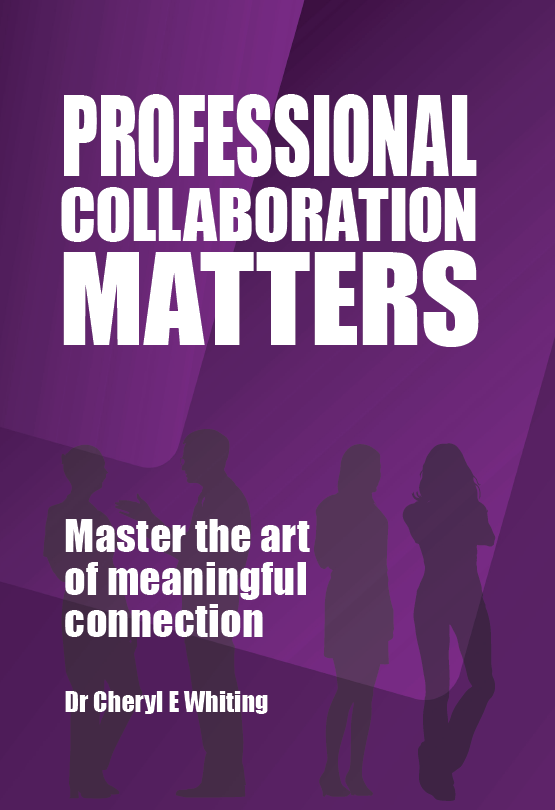
Dr. Cheryl Whiting’s upcoming work, Professional Collaboration Matters: Master the Art of Meaningful Connection:
Whiting argues that the greatest trap in modern professional ecosystems is the institutional pressure to quantify everything through metrics. When employees are reduced to data points, performance charts, or tasks on a screen, collaboration inevitably becomes transactional.
The Author’s Thesis: True collaboration begins when partners stop viewing each other as mere utility tools and start recognising one another as “whole individuals” working toward a shared goal. Building this connection requires cultivating an authentic and distinct professional culture that resists mere corporate superficiality.
The book deeply examines three critical layers that form the foundation of a sustainable, high-level partnership:
A. Suspending Assumptions (The Client & Peer Horizon)
As professionals, we frequently assume that our own definition of what is “right,” “efficient,” or “ethical” is universally shared. Whiting strongly challenges this:
We must actively acknowledge that individuals from different disciplines, cultures, or backgrounds view the professional landscape through entirely different lenses.
True collaboration does not begin by imposing our own framework; it starts with empathy—by listening to understand the underlying values and expectations of our peers.
B. Confronting the “Hidden Curriculum” of the Workplace
Drawing from her research in educational sociology, Whiting highlights the “hidden curriculum”—the unspoken rules and cultural pressures that operate beneath an organisation’s formal guidelines.
In most modern workplaces, this invisible framework relentlessly prioritises speed, short-term outputs, and blind efficiency.
The book demonstrates how this pressure erodes quality human interaction. Masterful collaboration requires consciously pushing back against this “race for speed” and shifting the focus back to a shared pursuit of excellence.
C. Excellence as a Transient State
One of the most striking philosophical points in Whiting’s work is that professional excellence and harmonious collaboration are never permanent achievements.
Excellence is transient. Much like an athlete who is only as good as their current performance, a professional is only as good as their current interaction.
Therefore, successful partnerships are not stagnant milestones. They are dynamic processes requiring continuous, active, and mutual investment in self-improvement.
Rather than viewing cross-disciplinary partnerships as a series of rigid “hand-overs,” the book treats collaboration as a shared intellectual and practical craft, offering several approaches:
Deep Listening and Authenticity: Communicating openly without hiding behind corporate masks, maintaining professional boundaries while preserving genuine human warmth.
Overcoming the “Good Enough” Trap: Accepting the status quo halts progress. As the author notes: “When we accept good enough, we impose limitations on ourselves and our expectations.”
Psychological Safety and Transparency: Whiting shows that teams capable of openly discussing mistakes and vulnerabilities—rather than maintaining an illusion of perfection—display far greater resilience during crises.
In an era where data and algorithms risk isolating the individual, professional success and institutional reputation rely heavily on the depth of our human connections. Collaboration is not a final destination, but an ongoing intellectual and interpersonal craft that must be practised every single day.
Copyright Professor Ethem Güneren, 2026 – shared with permission
Hello and welcome to the first instalment of my blog-to-book journey—a project designed not just to inform, but to generate conversation and engagement in my upcoming third book, “Train Better: Spend Less.” A practical toolkit for business leaders committed to cultivating professionalism through ongoing staff development, even when resources are stretched to their limit. If you’re keen to build a professional workforce that’s astute and adaptable, read on and stay tuned; more insights and creative ideas on how to make the best use of existing resources are coming.
The question on my mind this week is: Why do good intentions around training and development so often fizzle out?
Most of us would agree that training and development are very important.
It’s clear to us all: knowledge quickly becomes outdated, and skills fade or lose their relevance over time. Every day, we see how qualified, trained staff work productively and confidently, make fewer mistakes, and keep accidents and compliance issues at bay.
We know that if staff don’t remain sharp and adaptable, we risk getting left behind as the world races ahead. We also worry that our brightest, most innovative, and loyal team members may be drawn away by more inspiring opportunities elsewhere. A nightmare that strikes at both our hearts and our pockets.
With all this in mind, it’s obvious why training matters. Yet, unless it’s mandatory or lives depend on it, training rarely feels urgent. So, while we wholeheartedly believe in its value, all too often, it’s pushed to the bottom of the pile.
The very thing we value is often sacrificed.
This is not because we don’t care, but because the relentless pace of daily tasks, ingrained workplace habits, and financial pressures push it further down the list of priorities. As a result, training slips quietly into the background, overshadowed by everything else demanding our immediate attention.
With urgent deadlines looming and targets to meet, training becomes the thing we’ll get to when it’s quieter—but these moments never arrive. Taking staff away from their desks for personal development feels almost impossible when every pair of hands is needed, and finding cover or creating downtime is a juggling act few are willing to attempt.
Then there’s the classic “if it isn’t broke, don’t fix it” mindset. Unless staff are struggling, it’s tempting to believe yesterday’s approach will also see us through tomorrow. But that attitude can hold us back and allow us to pretend there is no need for improvement.
Even when we recognise there’s scope for enhancement, the real challenge lies in overcoming the capability gap by finding and shaping training opportunities that genuinely feel like personal and professional growth, not a box-ticking exercise or remediation.
Nor can we ignore the elephant in the room: training costs money, and its benefits aren’t always clear-cut. Measuring success or impact can be tricky, and without obvious results, it’s hard to justify the investment. Worse still, training can be uninspiring, generic, or poorly organised; it’s no wonder we doubt its ability to meet our business needs and drive the change and growth we hope for.
The key issue is that although we say training is valuable, our actions often paint a different picture, as we let practical challenges and ingrained behaviours push it aside.
So, what is it about our own circumstances that creates that gap?
The response to this question mainly depends on where we place ourselves on the spectrum between valuing training and development, creating room for it, and dedicating adequate resources to it.
This is not intended as a judgment but rather as an honest check-in.
Training and development, of course, come in many forms, whether it’s formal, classroom-based instruction, practical on-the-job training, or social, collaborative mentorship. A lack of training and development is not without reason. If we can identify our position and understand the root cause, we can begin to address the issue.
The answer gives us a starting point for deciding what needs to change, what support is needed, and which conversations are needed to move forward with a training and development strategy that closes the gap between intention and action.
Our approach to training and development should not focus solely on providing more training; it should ensure that the right skills are developed in the right people, at the right time and in the right way. Any training, whether delivered internally or externally, needs to be purposeful, targeted and aligned with our business needs and the personal and professional development we want staff to achieve.
What matters is that we find ways to prioritise staff development. This sends a clear message that staff potential is valuable and that our business is dedicated to thriving in a fast-paced environment. The journey will almost certainly require commitment and changes to habits, but the rewards—greater engagement, creativity, future success, and stability—will be worth it. It is often through small, manageable steps that we achieve our business goals: Training and development is no different. We see real changes in staff skills and a culture that values learning when we close the gap, and that gap is almost always closed through steady, intentional growth.
The question is: Are you ready to turn training and development into something you do, not something you promise?
If so, connect or follow me on LinkedIn for updates and articles focused on making ongoing training and development a reality through the optimal use of resources.
Written by Dr Cheryl Whiting, EdD, © March 2026
Thank you for taking the time to read this article. As always, your thoughts and feedback are welcome. Whether it’s a question, a shared insight, a suggestion for improvement, or a request to cover a particular topic in my blog series, please do get in touch.

February 2026 marked the completion of the first draft of my second book, Professional Collaboration Matters, a sequel to Professionalism Matters, published back in 2023. I cannot believe that I have written ‘the end’ for the second time. The material is by no means perfect, but over the coming months, I’ll be collaborating with editors, proof-readers, and publishers to bring this manuscript to life as a book.
I didn’t originally plan to write two books, but once I started writing, my mind kept generating new ideas. Having begun a literary conversation with Professional Matters, I felt compelled to keep it going, largely because there was so much more left to be said. Furthermore, having bumbled my way through writing the first, I thought it was only fair to have another go, applying what I had learned in the hope of refining my skills, just to be sure success was down to talent, not luck.
As I begin exploring ideas for a third book, I feel that the decision to keep writing isn’t so much a conscious choice as a quiet, inescapable pull towards another book, for reasons I’ll explain below.
Professional development is a topic that refuses to shrink
Having spent the best part of my academic career researching concepts of professionalism and exploring its impact on training, personal development, client satisfaction and outcomes, I thought I knew all there was to know about the subject, but clearly, I was wrong.
Professionalism Matters aimed to blend my academic insights with the real-life experiences of business owners. While interviewing such individuals about building strong client relationships, enhancing credibility, and establishing a positive reputation through professional practice, it became clear I was only scratching the surface. Conversations revealed that building and maintaining strong relationships with collaborative partners were just as important, but required a different set of skills, attitudes, and values. Professionalism remained central, but it appeared and felt different in the context of sustaining shared endeavours and securing long-term collaboration partnerships.
It was a fresh angle, a different theme that invited new questions and a deeper exploration of experiences. Since more detail and more examples would be necessary, the subject of professional collaboration seemed deserving of its own book. Those I interviewed, unknowingly, were already shaping my second book and guiding me towards putting pen to paper.
This wasn’t quite what I expected. I had hoped that after finishing the first book, I could finally sit back and relax, but it turned out to be the opposite. Suddenly, I found myself holding others’ thoughts and perspectives that would probably never come to light unless I articulated them, things I hadn’t even realised needed sharing until that moment. My interviewees were setting me off on a different intellectual journey, giving me a new purpose, so I couldn’t stop the bus even if I wanted to.
Writing develops you into a writer
Nothing prepares you for writing a book more than writing a book. The more you write, the more writing a book becomes less of a project and more of a way of life. My first book was really a warm-up act, a kind of apprenticeship, in which I learnt to write. More than this, I was able to recognise my habits, strengths and weaknesses, discover my creativity, find my voice, make mistakes, practice, and improve my skills. Between the first and the last words, a different writer emerged, who knew how to sustain momentum to create a book worth reading.
The act of writing changed me. By the end of book number one, I was no longer a novice. I had become more efficient and disciplined, confident that, by writing again, I would start from a place where I could refine processes, deepen my understanding, shape my voice, and sharpen my skills to craft a much stronger book.
Writing has become part of my identity
Writing becomes a way of thinking, and thinking naturally leads to writing. Writing for three hours each day is more than just a task; it’s now a fundamental part of my life. Writing has become a habit, and one that I’ve come to realise I love, mainly because writing expands my perspectives, skills, and ambitions, enriching the overall experience. It is a practice that fulfils me, reinforces my belief that my voice matters, and moves me closer to becoming the accomplished author I aspire to be.
Essentially, my first book was an exciting intellectual adventure that led to a second one built on ideas and lessons from the first, yet it is my growing confidence as a writer that motivates me to pursue a third.
The mix of experience, learning, and confidence has changed how I see myself
I am no longer just someone who writes, but a writer. I’ve learned to trust my ideas and voice, which gives me the confidence to pursue a new creative challenge that adopts a very distinctive approach, which until now didn’t feel possible.
In my earlier work, interviewing people made perfect sense; I was using their thoughts, ideas and examples of practice to strengthen my own point of view. The time is right to try something different, and instead of collecting others’ voices, I’m going to reclaim my own. For my third book, I will return to my core expertise: vocational education and training. As an educator, I am already sitting on work that deserves a second life and a coherent narrative. So, with a working title of ‘Train better, spend less’, it will be a book that draws on decades of personal knowledge and experience to help businesses maximise opportunities for staff development, even when budgets are tight.
Early days yet, and ideas are still embryonic; nonetheless, I’m going to take the brave step of making this a living project by adopting a blog-to-book approach. If there is one thing I wholeheartedly appreciated about my first two books, it was sharing the journey with others. My interviewees certainly kept me accountable and connected, offering encouragement and valuable feedback along the way. Not wanting to lose all that keeps the momentum going, I’m turning book number three into a shared journey through regular blog posts so everyone can follow my progress, comment, and apply what I am sharing without waiting until the end of the book.
My books are not just ideas and words; they are a journey of personal growth and discovery
A blog-to-book approach seems like a perfect way to share my progress and creativity, whilst changing practices and inspiring others. If you have ever felt the urge to share your story or feel you have a book in you, that’s just waiting to be written, then I encourage you to follow my lead. If you’re looking for further guidance and motivation, then do check out my blog “Thinking of writing a book? Here are 5 top tips to get you started.”
Regardless of your interest in professional development or writing, stay tuned for updates on my new writing adventure and the publication of my second book, Professional Collaboration Matters (out soon!) If you haven’t yet checked out Professionalism Matters, click here and find out more.
Here’s hoping as my journey continues, yours begins.
As always, your thoughts and comments on anything I write are most welcome, so please do contact me.
